Number of Visitors to site

Your 'avatar' tells me you follow my blog

Showing posts with label av kjv translators. Show all posts

Thursday, 14 April 2011

Andrew Bing – not quite anonymous.

Doctor Andrew Bing (Byng) was born in 1574, and lived seventy-eight years.

Academic credentials

Andrew Bing was a fellow of Peterhouse, Cambridge. He was appointed Regius Professor of Hebrew in Trinity College Cambridge in 1608. His predecessors were Edward Liveley (Director, First Cambridge company), Robert Spaulding (First Cambridge company) and Geoffrey King (First Westminster company).

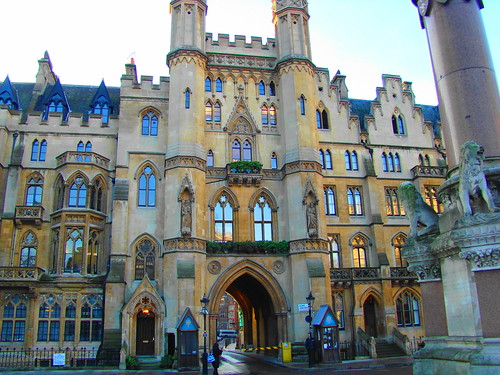
Like its sister college, Christ Church, Oxford, Trinity takes pride in its aristocratic connections — it has generally been the academic institution of choice of the Royal Family (King Edward VII, King George VI, Prince Henry of Gloucester, Prince William of Gloucester and Edinburgh and Prince Charles were all undergraduates). Like Christ Church, the college has also been associated with Westminster School. The Master remains to this day an ex officio member of the school's governing body.

Trinity has educated six British prime ministers and several heads of other nations. Among the alumni are Isaac Newton and Ludwig Wittgenstein. Its members have won 32 Nobel Prizes. Though Andrew Bing’s life and career is not quite anonymous, we can take comfort in the knowledge that the highest academic standards were present when Henry VIII first founded the College in 1546. Another alumnus of Trinity is John Stott, who as a student was a gifted student in French and Theology.


Dr. John Stott.(1921 - 2011)

There was a lot more emphasis on the importance of language study in depth, in an age when the physical sciences had not yet developed their alluring claim on students’ time and energies.

Appointed to translate

Andrew Bing was a tall, smiling young man, and merely 30 years of age when King James I of England chose him to work on the Bible. (1) He served on the "First Cambridge Company" charged with translating parts of the Old Testament for the King James Version of the Bible. The chairman of this group was Edward Lively, father of thirteen children. Others in the same group as Andrew Bing were Laurence Chaderton, Francis Dillingham, Thomas Harrison, Roger Andrewes, (brother of Lancelot Andrewes), and Robert Spaulding. The books they translated were I and II Chronicles, Ezra, Nehemiah, Esther, Job, Psalms, Proverbs, Ecclesiastes, and Song of Songs.

Not a great deal is known about this scholar, as is true of several of the names in a list of over 52 men who worked on the Translation. A study of these men’s careers enables the reader to build up a picture of their life-style and relationships:

[T]hey were bound together in a complex web of shared experience at both school and university and in a set of mutually reliant networks of clientship and patronage, by which leading members of the church promoted their favourites into well-rewarded positions of influence.” (2)

Other responsibilities

flickr.com

Dr. Bing was Sub-dean (deputy to the Dean) of York in 1606, responsible for running the York Minster Cathedral. Twelve years later, he was made Archdeacon of Norwich in 1618. “An archdeacon is often responsible for administration within an archdeaconry, which is the principal subdivision of the diocese. The office has often been described metaphorically as that of oculus episcopi, the bishop's eye.”

Andrew Bing outlived nearly all his fellow workers and died in 1652. By this time Oliver Cromwell was about to take the title of “Lord Protector” in running the Commonwealth after the execution of King Charles I.

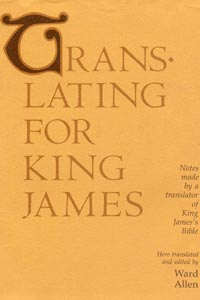
(1) Paine, Gustavus S. (1977/1959) The men behind the King James Version, MI: Baker.
(2) Nicolson, Adam. (2003) Power and glory: Jacobean England and the making of the King James Bible, Lon: Harper. p. 251.

This is 15/52. previous
Next Index

Friday, 1 April 2011

Thomas Ravis - a scourge of the Puritans.

Thomas Ravis was one of the six deans who attended the Hampton Court Conference in 1604. As a result, he was appointed director of the Second Oxford company involved in the creation of the King James Bible. This group translated the Gospels, the Acts and the book of Revelation. Sir Henry Savile and John Peryn were included in this group. Ravis later supplied notes for William Barlow's account, the Sum and Substance of the Conference.

Early days

Ravis was born in 1560 at Malden, in the county of Surrey, and died 1609. His education began at the famous Westminster School. Its list of old pupils display a galaxy of talent: Andrew Lloyd-Webber, Nick Clegg, John Locke, Charles Wesley, JN Darby, Sir Peter Ustinov, and winners of six VCs! – to name only a few. Later Ravis was to show great favour to students from his old school, encouraging and advising them in their studies (1)

Westminster School

In 1575 Ravis became a student of Christ’s Church, one of the Oxford Colleges, and founded by Cardinal Wolsey. The dean and chapter of Christ Church were reluctant to make a place for him, until a strong letter from William Cecil (Lord Burghley) overcame it. Over the next twenty years he pursued courses in both Arts (MA 1581), and Divinity (DD 1595).

Says McClure, “It is enough to record, that [the King James translators] nearly all attained to the highest literary honours of their respective universities.”

An influential cleric

He ‘took holy orders’ in 1582, and preached around Oxford for some time. From 1591 he was vicar of Allhallows Barking, in London for seven years. Then followed an appointment as Canon of Westminster, and two years after that he was made Dean of Christ’s Church College, Oxford. In 1596 he was elected Vice-Chancellor of the University. In 1598, he exchanged his All- hallows Church for the rectory of Islip. He also held the Abbey Church, in Wittenham Berkshire. These appointments took him into the inner circle of influential churchmen, where he rose fast in its elite social network, and he exercised a strong personal resistance to the Puritan influence of John Rainolds and his group.

In October 1604 Ravis was appointed Bishop of Gloucester, whilst still remaining dean of Christ Church, and holding his Westminster prebend, as well as the parsonages of Islip and Wittenham.

The Old Bishop's Palace, Gloucester
His holding a plurality of churches for the sake of their revenues, in neither of which he could perform the duties of the pastoral office [justified complaint] . . . The pernicious custom of pluralities, whereby a man receives tithes for the care of souls of which he takes no care, fleecing the flock he neither watches nor feeds, is one of those abuses still continued in the Church of England . . . [but not practised now]” McClure

A persecutor of Puritans

Thomas Ravis’s persecuting spirit towards the Puritans makes it difficult for biographers to commend him as a translator. Increasing conflict within the higher offices of the clergy made it certain that the list of translators would be staunch representatives of the then established order, where the authority of the bishop was ever more appealed to, in order to resolve the pain caused by conflicting viewpoints. Lancelot Andrewes appealed to episcopal authority at the Hampton Court conference with the words:

The occasion which caused the apostles to appoint bishops seemeth to be schisms . . . . The whole ministry of the New Testament was at the first invested in Christ alone. He is termed . . . bishop, 1 Peter 2: 25.”
No appeal was made to the Bible to justify the diocesan tradition where many congregations are ruled by one bishop. Edwin Hatch’s lectures tended to show that the earliest Biblical order was quite different,
For although it is indisputable that our Lord founded a church, it is an unproved assumption that the church is an aggregation of visible and organised societies. . . . The theory upon which the public worship of the primitive churches proceeded was that each community was complete in itself, and that in every act of public worship every element of the community was present.”(2)

Part of the New Testament evidence for the congregational view (assuming the authority of biblical precedent) is seen in Acts 20. There we read Paul gathered together at Miletus the elders (presbuteroi) of Ephesus. These same men are at the same time denoted “overseers” (episopoi: bishops) by the writer Luke, in Acts 20:17, 28. This shows that in the earliest times, instead of one bishop ruling many churches, it was the reverse, wherein several bishops (episcopoi: overseers) ruled one church, that is, one local congregation.

Paine says Ravis was “haughty and harsh” speaking against the Puritans at some length at the Hampton Court Conference. (1)

Ravis’ appointment as Bishop of London brought on a strong persecuting spirit in line with his predecessor, Richard Bancroft. He showed a severe exacting intolerance of all nonconformity. His determination to bring uniformity of outlook to his diocese made him blind to the virtues of those he opposed. For example, he interviewed, says McClure:

the holy and blessed man, Richard Rogers, [who was] for nearly fifty years the faithful minister of Weathersfield, than whom, it is said, “the Lord honoured none more in the conversion of souls.” In the presence of this venerable man, who, for his close walking with God, was styled the Enoch of his day, Bishop Ravis protested,--”By the help of Jesus, I will not leave one preacher in my diocese, who doth not subscribe and conform.”
The writer reposts:
The poor prelate was doomed to be disappointed; as he died, before his task was well begun . . . . So true is the remark, that “bishops and books are seldom the better for being translated.”

The term “bishop” was finally prominent in translating the pastoral epistles of Paul, being conspicuously used five times, where “overseer” would have allowed for the Puritan conviction that pastoral care is best exercised by someone present and directly involved in ruling a local congregation. It is hardly surprising that a company of translators, which included many bishops among them, would result in the final translation-product reflecting what was then the established order. The overall director, Lancelot Andrewes, with his high church leanings, had the final word, and he ensured it would be so!

A man of social affairs

In 1604, soon after Dr. Ravis was commissioned as a translator, he also became bishop of Gloucester. There

he spent lavishly on social affairs, and it was said that he ‘in so short a time had gained the good liking of all sorts that some who could not brook the name of bishop were content to give (or rather to pay) him a good report. He also constructed conduits to bring water into his bishop’s palace, built much of it anew, and improved the paving.(1)

His appointment was ostensibly for “his great learning, gravity, and prudence” and he seems to have been well accepted: “[Though] his diocese “was pretty well stocked with those who could not bear the name of a bishop, yet, by his episcopal living among them, he obtained their love, and a good report from them.” Paine calls him “stringent but sociable.” (1)

“Known as a ‘grave and good man,’ Ravis was able at getting work done and considered a model for lesser folk to revere, but clearly not a man without choler. In retrospect we may think him an odd choice for chairman of the group to work on the writing that contains the heart of Christian teaching.” (1)

His competence as a translator

Thomas Ravis would have learned Greek, Latin, Hebrew and Arabic as part of the curriculum of the upper school at Westminster in early days. Whether he excelled in these disciplines we are not told. There is no record of a particular aptitude for languages. Neither do we hear whether he immersed himself in the writings of the early Christian ‘fathers,’ whose work is so important in offering a critique of modern text-critical methods. Doubtless he would have kept in touch with classical languages during the twenty years which led up to his receiving a doctorate. However, his specialty seems to have been more to do with practical ecclesiastical affairs, and a doctrinal preoccupation with defeating the Puritan influence in church life.

“While he worked on the Bible, he was highly active as a hated scourge.” (1)

Notwithstanding, McClure gives Ravis the benefit of the doubt, saying:

Though too much carried away by a zeal for the forms of his Church, which was neither according to knowledge nor charity, he lived and died in deserved respect, and hath a fair monument still standing in his cathedral of St. Paul’s.

Ravis died on 14 December 1609, and was buried in the north aisle of St. Paul's Cathedral.

(1) Paine, Gustavus S. (1977/1959) The men behind the King James Version, MI: Baker, pp. 50-51, 93, 98, 104.
(2) Lang, G.H. (1959) The Churches of God Lon: Paternoster. P.15
(3) Wilson, Derek (2010) The People’s Bible: The remarkable history of the King James Version, OX: Lion, p. 100


This is 13/52. Previous Next Index

Saturday, 26 March 2011

Thomas Holland – Deep learning, strong conviction.

Thomas Holland was born in Ludlow, Shropshire in 1538/39, and was one of the older translators of the King James Version. He graduated from Exeter College, Oxford and became chaplain and Fellow of Balliol College in the same University.

Exeter College, Oxford

He was made Doctor in Divinity in 1584. The next year, when Robert Dudley, the well-known Earl of Leicester was made governor of the Netherlands – having just then been set free from Spanish rule - Dr. Holland went with him as chaplain, in 1585.

A man of solid learning

In 1589, Holland became the King’s Professor of Divinity at Oxford, for no obscure reason:

McClure says he was “so celebrated for his preaching, reading, disputing, moderating, and all other excellent qualifications, that all who knew him commended him, and all who heard of him admired him.”

He adds that under his leadership many distinguished scholars were trained up. Later in 1592 he served as Rector of Exeter College for twenty years. As a student, it was said of him, that he was so “immersed in books,” that academic pursuits overshadowed and dominated his entire life. The same could be said of many, perhaps all of the translators.

[This] office he filled with great reputation for twenty years, being regarded as a universal scholar, and a prodigy of literature. His reputation extended to the continent, and he was held in high esteem in the universities of Europe. These were the leading events in his studious life.

In his funeral sermon Dr. Kilby said of our translator:

that he had a wonderful knowledge of all the learned languages, and of all arts and sciences, both human and divine. He was mighty in the Scriptures; and so familiarly acquainted with the Fathers, as if he himself had been one of them; and so versed in the Schoolmen, as if he were the Seraphic Doctor [Thomas Aquinas].

The antiquarian Anthony Wood referred to him as “another Apollos, mighty in the Scriptures,” and besides, “a solid preacher, a most noted disputant, and a most learned divine.”

Contending for the Faith

Dr. Holland preached with gravitas and was intensely serious. When he discoursed off the cuff, he held an audience better than when he relied on the smaller details of an elaborate script.. For Holland, “contending for the faith” meant opposing Roman Catholic errors and expounding the Bible from John Calvin’s perspective. The latter’s teachings from Scripture formed the backbone of Holland’s Christian character, and in all his studious work he maintained an ardent devotion to God. He was a decided Puritan appealing against the prevailing standards of church ceremony and discipline.

He enjoyed debating difficult questions in the public University arena. For example, when he visited Oxford in 1604, the King, no mean scholar himself, liked to listen to a good academic argument with plenty of heat - all part of the royal entertainment. Holland and two other KJV translators, Giles Thomson and John Harding, argued for the negative when discussing the theological question, “Can the saints and angels read the thoughts of our hearts?” Dr John Anglionby, chaplain to the King (and to Elizabeth 1st before him) - yet another helper in the KJV translation - argued for the affirmative: yes, they can! Thomas Bilson, Bishop of Winchester, yet another translator, was the dialogue moderator in all this.

Paine says of this debate:

Though an appropriate choice for men of many minds, all on their good behaviour, the virtue of the question was that no one could answer it. It was therefore a perfect subject for a heated debate, a drill in what passed for logic, in the manner of the schoolmen of the Middle Ages. (1)

A fierce Puritan

“Fierce” is what Nicolson calls him (2). This is doubtless because of the famous contretente he had with the future Archbishop William Laud, as to whether bishops should rule the Anglican Church, rather than it be governed by elders.

William Laud

Archbishop Richard Bancroft (and Laud later on) had laboured all too successfully to introduce ‘popish innovations ‘at Oxford. Holland maintained against all comers that “bishops are not a distinct order from presbyters, nor at all superior to them by the Word of God. Thomas Holland had attempted to persuade the young Laud to a different opinion when the latter was taking his Divinity degree in 1604. Laud as a student contended “that there could be no true churches without diocesan episcopacy.” Dr. Holland issued a sharp public rebuke to him for what he foresaw as a prescription for a divided church, written by “one who sought to sow discord among brethren, and between the Church of England and the Reformed Churches abroad.” At that time the Calvinist party was strong in the Church of England. Laud's later insistence on the authority of ‘apostolic succession’ was unpopular in many quarters. His diminutive stature was satirised in the pun, "give great praise to the Lord, and little laud to the Devil."


But the bishops let him alone, as just Dr. Holland and harmless – a renowned old codger [now in or beyond his 60’s] whom all Oxford loved.

Thomas Holland must have been very preoccupied with the errors and idolatry wrapped inside Roman dogma, for Kilby - in the same funeral sermon – tells how whenever the scholar set out on a journey, he would first convene the Fellows of his College, and give them his favourite parting charge, that is, never failing to end with, Commendo vos dilectioni Dei, et odio papatus et superstitionis!! “I commend you to the love of God, and to the hatred of all popery and superstition!”(1)

A worthy translator

Holland was a member of the "First Oxford Company", responsible for the Major and Minor Prophets of the Old Testament, in the royal aim to create an ‘authorised version’ of the Bible for reading in the churches. He took a prominent part in what was the crowning work of his life.

Once translation days were over, Holland spent most of his time meditating and praying. Through his life, he had published several learned orations, also one sermon. Many manuscripts were ready for posthumous publishing, but they fell into unfriendly hands opposed to Puritan teaching, so were never published.

Sickness and the weakness of old age drew him closer to his eternal destiny and quickened the prospect of heaven. His biographer writes:

He loved and he longed for God, for the presence of God, and for the full enjoyment of Him. His soul was framed for heaven, and could find no rest till it came there. His dying prayer was— ‘Come, O come, Lord Jesus, Thou Morning Star! Come Lord Jesus; I desire to be dissolved, and to be with Thee!’ (1)"


He died and was buried with great solemnity in the chancel of St. Mary’s, Oxford on 16th March, 1612. Richard Kilby published his funeral sermon on Thomas Holland, in 1613. This was just a few months after the Bible was completed and published. He was 73: it was a religious age.

(1) Paine, Gustavus S. (1977/1959) The men behind the King James Version, MI: Baker, p. 85, 46-47, 155.
(2) Nicolson, Adam. (2003) Power and glory: Jacobean England and the making of the King James Bible, Lon: Harper. p. 254.

This is 12/52. Previous Next Index

Wednesday, 23 February 2011

John Peryn - "this one thing I do."

John Peryn - also spelt Perrin, Perin, Peryn, Pirryn, Pern or Perne. He was born at some point in the sixth decade of the 16th century, 155?. There is no apparent certainty as to his birthdate, so we don’t know at what age he started his education at Merchant Taylors' School - being resident in London. The school was at that time the largest in the country. His probable peers there were his fellow translators Thomas Harrison and Lancelot Andrewes.

The advantage of learning classics at Merchant Taylor’s school is clear. The school’s first headmaster, Richard Mulcaster, set out to “establish a rigorous curriculum which was to set the standard for education in Latin, Greek and Hebrew” in England. His goal was that English as a language might claim its place side by side with Latin.. He said:

I love Rome, but London better, I favour Italy, but England more, I honour Latin, but worship English.
flickr.com
We get a glimpse of this unique English foundation for later learning, where the emphasis on languages ancient and modern was so emphatic, that the timetable excluded both mathematics and science!! These latter were presumably seen as relatively unimportant compared to the supreme task of learning the ways of the world from the ancients (a reflection of other cultures. Clarity was obtained by reading the original languages, with the meaning less clouded through loss in translation.

One of the school inspectors of Merchant Taylor’s, Northwood, described how the school classroom operated:

The headmaster was required to open his [Latin] copy of Cicero at random and read out a passage to the Sixth form. The boys had to copy the passage from dictation and then translate it, first into English, then into Greek and then into Latin verse. After this, they had to write a passage of Latin and some verses on some topic chosen for the day. This was for the morning; in the afternoon the process was repeated in Greek, based on the Greek Testament, Aesop's Fables, "or some other very easie Greeke author". The standard in Greek was not as high as in Latin, but Hebrew was also taught.

Thus was the teenager John Peryn inculcated with the need to develop a scholarly approach to Greek and Latin, before he took his education to the third stage at Oxford.

Peryn matriculated at St John's College in 1575. Both Merchant Taylors' and St John's were founded by the same person: Sir Thomas White.

Sir Thomas White mtsn.org.uk

After four years Peryn graduated in Classics. St. John’s had begun only twenty years earlier for the purpose of educating Roman Catholic clerics to support the Counter-Reformation under Queen Mary. It existed primarily to produce Anglican clergymen in the earlier periods of its history. St John's also became well-known for effective teaching of both law and medicine. During the four years following his graduation, Peryn no doubt taught in the University, receiving his Master’s degree in 1579. Further teaching and study for six years saw him graduate in Divinity, which focused on the study of religious Greek and Latin texts. With the passing of another seven years he accepted a doctorate in Divinity, 1596. By this time, he was Regius Professor of Greek. This was a post he actively held for six years until 1605, at which point he was nominated to the Second Oxford Company of translators by King James.

St. John's College, Oxford.

The Regius Professorship of Greek is a position at the University of Oxford, founded by Henry VIII, fifty years before Peryn was given the chair. The King established five of these in Oxford - in Divinity, Medicine, Civil Law and Hebrew. These Professorships were created with royal approval, also at the ancient universities of Oxford, Cambridge, St Andrews, Glasgow, Aberdeen, Edinburgh and Dublin. Peryn held his post – in theory at least - from 1597 to 1615.

When nominated to the Second Oxford Company of translators by King James, he found it too burdensome to continue to actively teach, and was able to opt out of his duties for a period starting January 1605.(2) He was more interested in helping to ensure an intense focus and a high standard of excellence for the new translation. Perhaps, too the formidable reputation of Lancelot Andrewes as a linguist was an inescapable challenge to his integrity as a scholar. So, he left College teaching to other fellows, and channeled all his energies in one direction. It seems no replacement for Peryn was found until 1615 when John Hales was appointed. This is a good example for us, in the need to give God’s Word priority in our lives. St Paul’s example to us was encapsulated in his, “this one thing I do,” rather than in saying, ‘these fifty things I dabble in’! Peryn found himself an unusually willing “workhorse” of the translation committee. (1)

flickr.com

Peryn also held other posts at the time of the commission. He became a canon of Christ Church Cathedral, Oxford, in 1604.(3) A canon is a priest or minister who voluntarily subjects himself to an ecclesiastical rule (Gk. kanon = rule). The title now relates particularly to cathedral churches, the seats of Anglican bishops. A canon and his fellows make up a chapter, headed by a dean, and together they are responsible for administering the affairs of a cathedral. Thomas Ravis, a fellow translator, was dean of the chapter in 1596 and was still leading it when Peryn was appointed in 1604. But, did Peryn resign this position, as well as ceasing to teach in the lecture room? (1) Not according to British History Online.

Peryn is said to have become vicar in Worthing, Sussex around this time, through the influence of Lancelot Andrewes (1) However, at that time the community had no Anglican church, the nearest being St Mary’s church Broadwater, which was adminstered by a rector, not a vicar.

Peryn died not long after the KJV was published, on 9 May, 1615. He was probably one of the unsung heroes, among the translators of the King James Version.


1. Nicolson, Adam. (2003) Power and glory: Jacobean England and the making of the King James Bible, Lon: Harper. p. 154.
2. David Norton, A Textual History of the King James Bible (2005), p. 12.


This is 8/52 Previous Next Index

Tuesday, 11 January 2011

John Bois – Boy genius!

John Bois was the son of a Suffolk clergyman, William, who was exceptional for being equally learn-ed in Hebrew and Greek. William had lost several children, and was determined to pour his knowledge into his son from the beginning. “He taught John so well that he had read the whole Bible through, surely at his mother’s knee, by the time he was five. .”(1) Says, Alex McClure,“By the time he was six years old, he not only wrote Hebrew legibly, but in a fair and elegant character. Some of these remarkable manuscripts are still carefully preserved.” Such a high-pressured, intellectual upbringing made him ready for University (Cambridge) by the time he was 14! He at once made himself at home by writing letters in accomplished Greek to the Master of his College (St. John’s), and to the “fellows” who taught there. Most of us, who have studied some Greek have trouble even reading it, let alone writing letters in it. His Greek professor was another highly accomplished translator of the KJV. “Andrew Downes’ eyes sparkled at the arrival of such a boy. Bois already knew more Greek than any other scholar in the college. And Downes clearly loved and nurtured him.” (1)

McClure tells us more: “In addition to his lectures, which Dr. Downes read five times in the week, he took the youth to his chambers, where he plied him exceedingly. He there read with him twelve Greek authors, in verse and prose, the hardest that could be found, both for dialect and phrase. It was a common practice with the young enthusiast to go to the University Library at four o’clock in the morning, and stay without intermission till eight in the evening.” Which of our contemporary translators were studying in Greek the works of Hesiod, Homer, Plato, Aristotle and St. Paul by the time they were 16? When a boy starts reading ‘in the dark’ at four in the morning, and skips his meals for the sake of sixteen hours of intense language study, this shows a voracious appetite for exact scholarship.

In the interests of exact grammar, he had read through sixty grammars (2). John Bois became chief lecturer in his college for ten years and expected his fellow teachers to attend his own Greek lecture every week in his rooms, usually at four in the morning, with the men sitting round the candlelight!

John Bois was chosen to translate the Greek Apocrypha in one of the two Cambridge groups of translators. [See “Translating and Revising” for the value of the Apocrypha.] Bois also came to the rescue of the first Cambridge group who were working on the Hebrew Old Testament, when its chairman (Edward Lively) prematurely died. After several years work, the time came for all the newly translated books to be revised. Bois was chosen as the chairman of this group of six to twelve men from the six companies. He left us some valuable notes in Latin. They give us valuable insight into how they did their work, what detailed discussions they had when deciding between different renderings of a word, phrase or sentence. MAV gives several specific examples from these notes as to how they made their textual choices. Nicolson asks, “Was the conversation in the general meeting also in Latin, the lingua franca of international scholarship, in which these men had been steeped for decades? The atmosphere of Bois’ notes at least seems to hint at that. There are long disquisitions in Latin peppered with Greek words and phrases.”(3)

Bois notes show the translators knew Greek so well that they realised interpretation of the Text should be kept to an absolute minimum, if they were to do justice to the New Testament writers. This meant deliberate ambiguity in many places. It is safe to say they considered more options on the meanings of words and sentences than our contemporary translators do today, because their knowledge of the language was so much greater. Whereas the opposite is often assumed. An example of this is the way they translated 2 Cor. 2:17. James White, who is no apologist for the KJV, says for example: “If the KJV translators were alive today they would gladly admit that peddle is a better translation than corrupt, and would adopt it themselves.” (4) Bois notes’ show James White made a serious misjudgement of their linguistic skill in saying this. See the proof in “Knowledge of Greek”

But there was more to Bois than what some like to refer to as “mere scholarship.” He was evidently a godly and obedient man, though not without flaws and faults, like us all. To the poor he was charitable, to the unlettered in church he was a model of simplicity when teaching God’s Word. He made time in his marriage for good conversation. He prayed with [his seven children] every day, kneeling with them on the bare bricks of the . . . parsonage floor.”(3) One example of his genuineness is shown in the conflict he got into with another translator, Sir Henry Savile. Savile looked to Andrew Downes and Bois for help with his mammoth eight-volumed edition, which translated all the works of the Greek writer St. Chrysostom. But in the process of referral, Savile seemed to give greater credit to Bois, because the author asked him to check the notes of his master Downes. It seems the latter’s jealousy causes a permanent estrangement with Bois. Whereas, Bois - who was all for the peaceful middle way - went on praising his former teacher. In so doing he illustrated the import of his own notes, which recorded the group discussion of Romans 12:10: “In honour preferring one another,” Bois explains this as, “let each one of you strive to prevail in giving honour to another.” See also the final paragraph under Knowledge of Greek for illumination on 1 Peter 5:5 in a similar vein

“Bois, with his finicky precision, the awe-inspiring hours he devoted to his work, his monk-like removal from the world, was as great a scholar as England could provide.” (3) MacClure tells us he had memorised the Greek New Testament by heart!! “He was so familiar with the Greek Testament, that he could, at any time, turn to any word that it contained. . . . . He expired, on the Lord’s Day, January 14th, 1643, in the eighty-fourth year of his age. “He went unto his rest on the day of rest; a man of peace, to the God of peace.”


(1) Nicolson, Adam. (2003) Power and glory: Jacobean England and the making of the King James Bible, Lon: Harper. p. 203 - 204.
(2) Paine, Gustavus S. (1959/1977) The men behind the King James Version, MI: Baker, p. 67.
(3) Nicolson, pp. 207, 208, 210.
(4) White, James R. (1995/2009) The King James Only Controversy, MI: Bethany House, p. 158.

PS. This is 2/52 in centennial celebration. Previous Next Index